


Elżbieta Foltyńska (1957-2024)
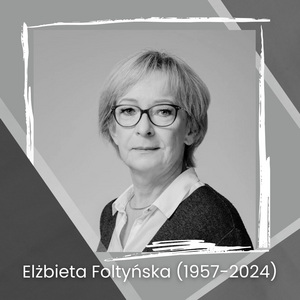
Elżbieta Foltyńska spent almost half a century in the Institute of English Studies, first as a student, and then from 1980 as a member of staff, employed in the Department of the Cultures of the English-Speaking World. She was always a positive presence in the Institute – courteous, chic and until very recently inseparable from a chain of cigarettes. In the early years, when smoking by teachers was accepted practice, this was true even during classes.
Elżbieta had a talent for friendship, forming close links with those around her in all the surroundings of her life, for example in the new housing block in Ursynów that she moved into in the 1980s, where she was immediately on first-name terms with all her neighbours. She formed close links because she was unselfishly interested in other people; she remembered their concerns and their problems, she believed in them and wanted to help them.
This involvement with others was a sound foundation for her work in the Institute as Deputy Director for Student Affairs (or latterly, after a name change for the function, Director of Studies – Kierownik Studiów) a role that she played from 2005 until her death in 2024. Elżbieta understood that students were the most important part of the university community. She was extremely conscientious in all areas of the role and in particular in finding solutions to the problems of individuals. In the first period of her work as director, there was always a long queue outside her office of students waiting for help, and Elżbieta never left anyone without suggestions of ways to solve their problems. And I think it would be fair to say that this pattern of personal contact with individuals appealed to Elżbieta more than the depersonalised patterns that developed in the last years of her term of office, when increasingly standardised requests were processed online.
It was not only students who appreciated her inter-personal skills. Elżbieta was discreet as the recipient of confidences from a wide range of colleagues. She was also loyal, never forgetting older and retired colleagues, like Prof. Stanisława Kumor, whom on many occasions after meetings in the Institute she drove back to a distant country residence in the middle of a suburban forest. Prof. Ewa Kębłowska-Ławniczak of the University of Wrocław wrote in a farewell tribute that Elżbieta was: ‘someone on whom you could unreservedly rely and who through an inborn delicacy and tactfulness helped to sort out inter-personal matters, including very difficult ones.’ In this she was also assisted by a well-developed sense of humour which could ease most situations.
Elżbieta was first employed as an assistant lecturer who had eight years to write a Ph. D. thesis, which she planned to deal with the Polish-language press in the United States, something in which she became interested when visiting relatives in the States as a student. The proposed title of the thesis was ‘The Polish-American press as a link between cultures’, which she undertook under the supervision of Prof. Marek Gołębiowski. This thesis was never completed, partly because she spent most of the 1980s on extended maternity leave, returning full-time to the Institute from 1988. She may not have produced a thesis but Elżbieta read widely and kept her finger firmly on the pulse of the society and culture of the United States. Throughout her career she taught classes in American Life and Culture (‘Wiedza o Stanach Zjednoczonych’) and also elective courses on the American press, all of which enjoyed a great deal of student interest.
In addition to teaching, Elżbieta was always prepared to give up time to work for the general good. Before becoming Deputy Director of the Institute, she was, for example, a member of the Institute admissions committee for several years in the first decade of the 21st century; she was annually an examiner for the Olimpiada Języka Angielskiego between 1999 and 2002; she served as a representative of junior staff in the Institute Council and was secretary of the Council for three years; she also served for six years as a member of the Faculty Electoral Commission.
She moreover taught in newly-formed teacher training colleges which were opened under the supervision of the Institute in the 1990s, travelling to Ciechanów and Siedlce to give classes on American Culture. She did not limit her activities to the University of Warsaw, but was an active member of PASE, the Polish Association for the Study of English. She took part in the founding conference of the Association in 1991 at Mogilany near Kraków and thereafter regularly attended the association’s annual conferences. She served as Secretary of the Association for three terms of office until 2018.
Elżbieta was resolute and brave. She fought consistently against adversity and never complained, even in the final stages of the illness that took her from us too early.
Emma Harris